
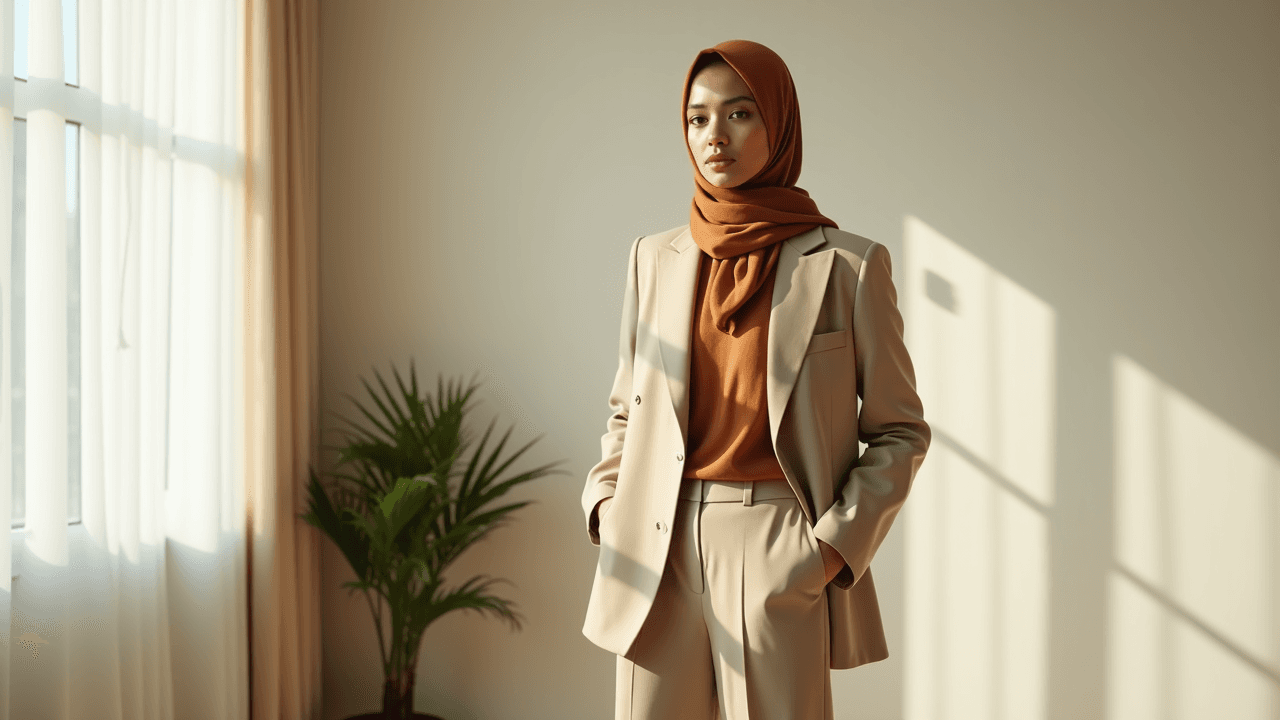
The first photograph I can find of myself in hijab shows a woman I barely recognize. Not because of the headscarf—because of the outfit underneath. A shapeless black tunic, trousers a size too large, flat shoes chosen for invisibility rather than intention. I had confused modesty with disappearance.
That was four years ago. Today, my wardrobe contains more deliberate pieces than it ever did before: a Verona Collection silk midi dress in deep olive that I wear to client meetings, Haute Hijab's modal wraps in colors I rotate seasonally, a structured Aab blazer that cost more than anything I owned in my twenties. The coverage is greater. The style is sharper. The confidence is harder to explain but impossible to miss.
This piece examines what actually changes—practically, aesthetically, psychologically—when women begin wearing hijab. Not the spiritual dimension, which belongs to each individual. The fashion dimension, which is ScanJab's territory.
The Fear That Rarely Gets Named
Spend time in online communities where Muslim women discuss modest dressing—Reddit's r/Hijabis, private Instagram comment threads, WhatsApp groups—and certain anxieties surface repeatedly.
One user on r/Hijabis, posting anonymously, wrote: "I want to start wearing hijab but I'm scared I'll just look like a blob. All my style is in my hair and my fitted clothes."
Another, responding: "Took me two years to feel like myself again. The first year was rough."
These aren't isolated sentiments. The fear of losing personal style sits alongside deeper concerns about identity, femininity, and social perception. For women who built confidence around particular aesthetics—whether that meant statement hair, body-conscious silhouettes, or simply the familiar—adding coverage can feel like subtraction.
The fashion industry hasn't helped. For decades, mainstream retailers treated modesty as an afterthought: longer hemlines offered in black only, sleeves added as an accommodation rather than a design feature, "modest" sections tucked into website corners. The message, however unintentional: coverage comes at the cost of creativity.
What Actually Changes in the Wardrobe
Let's be specific about the practical shifts.
What typically goes: Backless tops, mini hemlines, sleeveless dresses without layering options, sheer fabrics without underlayers. For most women, this represents a fraction of an existing wardrobe—often pieces that were already gathering dust.
What stays and adapts: Midi and maxi skirts, wide-leg trousers, blazers, cardigans, most footwear, most bags, most jewelry. A well-cut pair of Massimo Dutti trousers works as well with a tunic and hijab as it did with a tucked blouse.
What gets added: Base layers for necklines (mock-neck underlayers, typically in neutral modal or cotton), longer-line tops, and—the most significant investment—the hijabs themselves.
The financial outlay varies dramatically. A basic modest transition might cost under £150: a pack of jersey hijabs (Haute Hijab's everyday collection runs approximately £12–15 per piece), three or four long-sleeve base layers, and one or two tunic-length tops. A more comprehensive rebuild, incorporating premium pieces from brands like Aab (blazers £80–120), Inayah (dresses £65–95), or Bouguessa (abayas from approximately £400), can run into the thousands.
The hidden cost is time. Learning which hijab fabrics work for your face shape, which draping styles suit your proportions, which colors complement your skin tone—this knowledge accumulates through trial, error, and often a growing pile of scarves that looked different online.
The Style Vocabulary Shifts
When I asked modest fashion content creators what changed most about their approach to dressing, answers clustered around three areas.
Proportion becomes primary. Without fitted silhouettes as a default, understanding how pieces balance against each other grows more important. A wide-leg palazzo trouser needs a different top length than a straight-leg style. An oversized blazer demands more structured fabric to avoid shapelessness. Several women mentioned that modest dressing taught them more about fit than anything they'd learned before.
Color carries more weight. When visible skin decreases, fabric color becomes the dominant visual element. Many modest dressers develop more deliberate color strategies over time: seasonal palettes, signature tones, intentional contrast between hijab and outfit. The burgundy-and-forest-green combinations common in Gulf-influenced styling, or the cream-and-terracotta pairings popular in Turkish modest fashion, reflect this heightened attention.
Texture distinction sharpens. Silk hijab against a wool coat. Crepe dress over jersey underlayer. Cotton trousers beneath a structured blazer. Fabric mixing becomes a conscious styling tool rather than an accident.
Regional Styles Differ More Than Outsiders Realize
The term "hijab style" obscures enormous variation in how Muslim women approach coverage across regions and communities.
Turkish draping typically involves larger square scarves wrapped to cover the neck fully, often with volume at the crown. Brands like Modanisa stock thousands of Turkish-style silk and chiffon squares, usually 90cm or larger.
Malaysian and Indonesian styles often feature instant hijabs—pre-sewn pieces that slip on without pinning—in jersey or chiffon, sometimes with decorative folds built in.
Gulf aesthetics may incorporate the shayla (a long rectangular scarf draped loosely over the head and shoulder) worn with abayas, creating fluid, monochromatic silhouettes. Emirati and Saudi designers like Bouguessa and Arwa Al Banawi have built international reputations on elevated interpretations.
Western minimalist approaches, visible in brands like Haute Hijab and Veil Garments, emphasize wrinkle-resistant fabrics, neutral color ranges, and styles compatible with workplace dress codes.
No single tradition represents "correct" hijab styling. ScanJab's catalog reflects this diversity—search results pull from Turkish marketplaces, British DTC labels, Gulf luxury brands, and American modest startups.
The Confidence Question
The psychological shift that women describe after starting hijab doesn't fit neatly into either celebratory or skeptical frameworks.
Several women I spoke with described initial drops in confidence. Getting dressed took longer. Outfit combinations that worked in theory looked wrong in practice. Social interactions felt different—sometimes due to actual treatment changes, sometimes due to heightened self-consciousness.
But over time—typically six months to two years—something else emerged. Descriptions varied: "I stopped performing for other people's expectations." "I learned what I actually like instead of what I thought I should like." "My clothes feel like choices now, not defaults."
There's a selection effect here worth naming: women who remain unhappy with hijab often remove it, while those who find it meaningful persist. Any survey of current hijab wearers will overrepresent positive experiences. This doesn't invalidate those experiences, but it does mean the narrative "hijab leads to confidence" oversimplifies a more complex reality.
What seems more defensible: the constraint of coverage can function as a creative catalyst for those who engage with it actively. The same principle applies to capsule wardrobes, uniform dressing, and other intentional limitations that force deliberate choices.
Building the Wardrobe: A Practical Framework
For women approaching modest dressing for the first time—whether for religious reasons, personal preference, or professional contexts—certain investments deliver disproportionate value.
The base layer foundation. Modal mock-neck tops in black, white, and one skin-complementing neutral. Verona Collection and Haute Hijab both offer fitted versions designed to sit smoothly under outer layers. Budget approximately £15–25 per piece for quality that withstands regular washing.
The everyday hijab rotation. Start with jersey for low-maintenance daily wear (doesn't require pinning, stays in place, travels well), then add chiffon or modal for slightly dressier contexts. Five to seven pieces in a considered color range will cover most situations. Premium jersey hijabs from Haute Hijab (approximately £15 each) or Aab (approximately £18 each) outlast fast-fashion alternatives significantly.
The versatile modest dress. A midi or maxi length, long sleeves, fabric substantial enough to hang properly without clinging. Inayah's shift dresses (approximately £70–90) and Aab's structured maxis (approximately £65–85) serve both workplace and weekend contexts.
The structured layer. A longline blazer or coat that provides additional coverage while adding polish. Standard retailers like COS, Arket, and Massimo Dutti often work here; modest-specific brands like Aab and Louzan offer cuts designed with layering in mind.
The occasion piece. One elevated option for weddings, Eid, or formal events. This is where investment makes sense: an Inayah evening abaya (approximately £150–200), a Bouguessa structured piece (£400+), or a well-chosen vintage find.
Total initial investment for a functional modest wardrobe: approximately £300–500 at mid-range quality, though budget approaches (H&M, Primark basics plus Modanisa hijabs) can achieve coverage for under £150.
What the Market Reflects
The modest fashion sector—valued at approximately $280 billion globally according to the State of the Global Islamic Economy Report—has matured significantly since 2015. What once required hunting across multiple countries' retailers now surfaces through aggregated search.
This shift matters practically. A woman in Manchester seeking a navy modest maxi dress with pockets no longer needs to know that Inayah stocks one, Aab offers a similar silhouette, and Modanisa carries several Turkish options at lower price points. Aggregation surfaces options across brands, allowing comparison by price, fabric, review quality, and shipping terms.
ScanJab's positioning within this ecosystem focuses on search rather than curation: entering "navy modest maxi dress" returns results from dozens of shops, filterable by price range and retailer. The goal is discovery efficiency—reducing the time between "I need this piece" and "I found it."
The Expression Remains
The woman crying in front of her mirror, fearing she'll disappear—this is a real experience, reported frequently enough to deserve acknowledgment. So is the woman who, years later, describes her style as more confident, more deliberate, more hers.
These aren't contradictory. They're sequential. The transition involves genuine difficulty, and the outcome involves genuine reward—for those who continue.
What doesn't happen, in most accounts: the permanent erasure of self-expression. Coverage changes the vocabulary. It doesn't end the conversation.
For modest fashion resources across hundreds of brands and shops, visit [ScanJab](https://scanjab.com).