
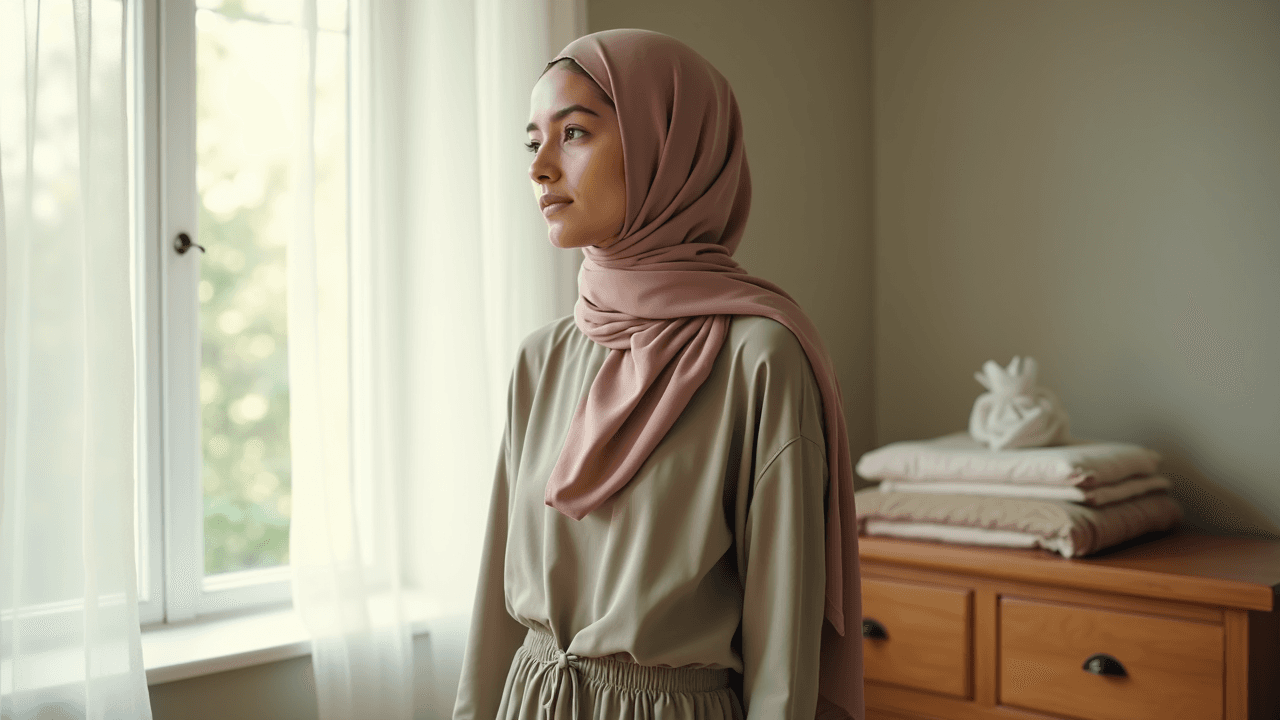
# I Was Afraid to Start Wearing a Hijab
The day I bought my first hijab, it stayed in the shopping bag for three weeks. It sat on my dresser, tissue paper still crisp, price tag attached, while I rushed past it every morning getting ready for work. I told myself I was waiting for the right moment. The truth was simpler: I was scared.
That quiet fear—the gap between who you are and who you're becoming—runs through countless conversations among Muslim women considering hijab. It rarely appears in glossy magazine features or Instagram transformation posts. But in group chats, Reddit threads, and late-night phone calls, the same questions surface: What if I'm not ready? What if I fail at this? What if everything changes?
This is a personal account of that fear, and of moving through it. It is not a guide, not a prescription. Other women's paths will differ. But if you're standing where I stood—staring at an unworn scarf—perhaps recognizing the shape of that hesitation will help.
What the Fabric Carries
To understand the fear, you have to understand what the hijab holds.
Physically, it's a headscarf covering hair, often draping over shoulders and chest. For Muslim women, it carries weight beyond fabric. It's a visible marker of faith in spaces that may view Islamic practice with suspicion. It reshapes how strangers see you, how colleagues address you, how you move through airports and job interviews and first dates.
Some women grow up wearing it, the hijab as familiar as a school uniform. Others come to it later—after marriage, during Ramadan, following loss or spiritual shift. There is no single script, which makes the decision heavier. Without a prescribed moment, you must find your own.
The fear, I found, was rarely about the cloth itself. It was about identity, visibility, and stepping into a version of myself that could no longer go unseen.
Watching, Waiting, Searching for Permission
I spent months looking for permission in other women's stories. Not from scholars—from peers. Friends who'd made the transition. Cousins. Women on YouTube who looked like me and admitted they'd been nervous too.
The modest fashion creators I followed mattered not for their tutorials but for their honesty. They showed imperfect hijab days alongside polished looks. They talked about doubt. One video I watched three times featured a woman saying, "I almost took it off last week." That admission gave me more than any confident transformation story could. It told me I was allowed to struggle.
What I needed wasn't certainty. It was evidence that I could begin before I felt ready.
The Practical Weight
Beyond the spiritual and emotional, there were logistics. Most of my wardrobe no longer worked. Mainstream retailers offered little—everything cropped, sheer, or cut low in back. I spent weekends returning online orders that photographed modestly but failed in person.
The modest fashion market has grown substantially, though statistics on its size vary by source and methodology. What I can say from experience: finding brands that design for coverage-first requires knowing where to look. Inayah became my workwear anchor—their tailoring holds up, and the fabrics don't cheapen after washing. For hijabs themselves, Haute Hijab offered timeless staples that stayed put during a bustling day. Each piece from these collections became part of my evolving style.
Aggregator platforms like ScanJab, which pull modest pieces across retailers, have made discovery easier and affirming. Browsing sites dedicated to modesty, rather than navigating filters on general platforms, transforms the experience from isolating to inclusive.
A Wednesday Morning
The shift happened on an ordinary Wednesday.
I was getting ready for work, running late as usual, and I put it on. No ceremony. No religious holiday. I hadn't told anyone I was planning to. I just walked out the door.
The commute felt surreal. I was certain everyone was staring. My heart wouldn't slow down. At the office, my hands shook making coffee. One colleague asked if I was cold. Another said, "Nice scarf," with no apparent awareness of what it meant. By noon, the panic had faded. By the end of the week, it was simply what I wore.
The fear didn't vanish. But it quieted. What replaced it—the sense of my outside finally matching my inside—was louder.
What I Didn't Expect
I expected stares. I got some. I expected questions. Fewer than anticipated.
What I didn't expect was how ordinary it would become. The hijab integrated into my routines faster than I'd imagined. Certain anxieties—about professional perception, about losing parts of my social life—didn't materialize the way I'd built them up. Others did. Some friendships shifted. A few family members had opinions I hadn't predicted. These complications were real but survivable.
I also didn't expect how much the available fashion would matter. A decade ago, modest options skewed frumpy—functional but rarely beautiful. Designers today, however, are challenging that narrative. Labels like Bouguessa offer chic abayas that fit boardrooms and social gatherings. When I found pieces that made me feel sharp or confident, the hijab transformed from a symbol of limitation to a facet of self-expression.
For Anyone Standing Where I Stood
The dusty rose chiffon hijab I left in that shopping bag is still in my collection. I don't wear it often—chiffon slips too much for practical days—but I keep it. It reminds me of the woman I was before.
The fear never fully disappears. It flares in new situations—interviews, unfamiliar cities, rooms where I'm the only one covered. But it no longer runs things. Alongside it now are conviction, comfort, a quiet pride that has grown stronger with time.
Starting to wear hijab isn't about erasing doubt. It's about deciding that the life you want matters more than the fear. It's about showing up—pins crooked, outfit uncertain—and continuing anyway.
If you're standing where I stood, looking at an unworn scarf, here's what I'd offer: you don't have to be ready. You just have to begin. The readiness builds as you go.
---
*Browse coverage-first edits on ScanJab when you're ready to shop the looks from this story.*