
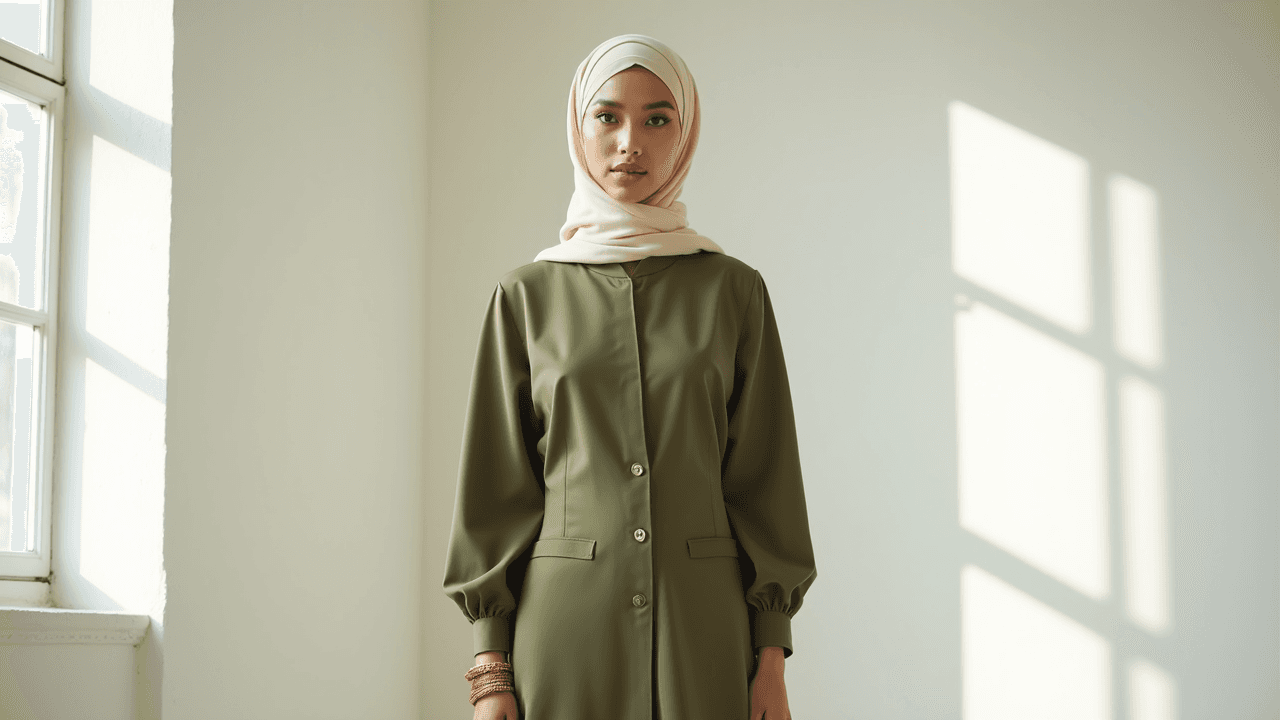
Finding workwear that meets both corporate dress codes and personal coverage preferences remains one of modest fashion's most persistent practical challenges. While mainstream retailers have added "modest" filters and capsule collections, the solutions often miss fundamental construction details—sleeves that ride up, necklines that gap, fabrics too sheer for layering-free wear.
The brands gaining traction in this space aren't retrofitting existing designs. They're engineering from coverage-first principles.
The Construction Problem
Standard professional clothing assumes certain styling defaults: collarbone exposure, elbow-length sleeves as "long," fabrics selected for silhouette rather than opacity. For women who dress modestly—whether for religious practice, personal preference, or workplace comfort—these defaults create daily friction.
Inayah's 2024 workwear collection addresses this through what the brand's design team describes as "coverage engineering." Their structured blazers feature interior sleeve weights that prevent riding, while blouse necklines sit approximately two inches higher than standard cuts. The technical details matter: a blazer that gaps when buttoned isn't modest regardless of its sleeve length.
Aab takes a different approach, focusing on layering pieces designed to work as complete systems. Their ponte pencil skirts pair with longline tunics cut specifically to maintain coverage when seated—a problem familiar to anyone who has spent a meeting tugging at a top's hemline.
Market Sizing the Demand
The modest fashion market, valued at $295 billion globally in 2023 according to the State of the Global Islamic Economy Report, includes professional wear as a significant but underreported segment. Brands don't typically break out workwear sales separately, making precise sizing difficult.
What's measurable is search behavior. Google Trends data shows "modest workwear" searches increased 34 percent year-over-year in the UK and US markets between 2022 and 2024. "Hijab-friendly office wear" and "modest interview outfit" show similar trajectories.
The demand signal is clear even if precise market value isn't: women are actively searching for solutions that don't fully exist at scale.
Brand Approaches
Haute Hijab, originally focused on headscarves, expanded into apparel in 2021 specifically because customers requested coordinated professional pieces. Their Everyday Collection includes ponte blazers and wide-leg trousers designed for hijab styling—higher back necklines, structured shoulders that accommodate layered fabric at the neck, and sleeve lengths that account for arm movement without exposure.
Verona Collection, founded by former corporate professionals, built its line around boardroom requirements. Their "Executive" pieces use substantial fabrics—primarily crepe and heavy ponte—that eliminate the need for underlayers. Pricing sits in the $80-$150 range per piece, positioning the brand between fast fashion and contemporary designer.
Bouguessa's approach comes from the luxury end. The Dubai-based brand's tailored pieces, often exceeding $500, use architectural construction to create dramatic modest silhouettes. Their client base, according to founder Faiza Bouguessa in a 2023 interview with Harper's Bazaar Arabia, includes "women who want investment pieces that work from the office to evening events without changing."
The Fit Challenge
Even with coverage-first design, fit remains complicated. Standard sizing assumes proportions that don't account for layering or for body types underrepresented in mainstream fashion.
Annah Hariri addresses this through made-to-measure options on selected pieces, adding approximately two weeks to delivery time but ensuring sleeve length and torso coverage match individual measurements. The service costs $25-$40 per garment beyond base price.
Inayah publishes unusually detailed measurements—not just bust, waist, and hip, but sleeve circumference at the wrist, neckline height from collarbone, and back length from nape to hem. The granularity helps customers assess coverage without trial and error.
What's Still Missing
Gaps remain substantial. Modest suiting—matching blazers and trousers in coverage-first cuts—exists at limited price points. Options cluster at either fast-fashion (under $100 for both pieces, quality compromises common) or premium (over $400, limited availability).
Summer professional wear presents another challenge. Breathable modest fabrics that maintain opacity and structure in warmer months are technically difficult to produce at accessible prices. Linen wrinkles and can be sheer; cotton blends may lack structure; synthetic options trap heat.
Several brands are experimenting with solutions. Modanisa's marketplace model aggregates options across dozens of brands, though consistency varies. ScanJab's catalog approach similarly consolidates discovery, allowing comparison across modest workwear from multiple brands through a single search at [scanjab.com](https://scanjab.com).
The Broader Shift
Corporate dress codes themselves are evolving post-pandemic, with many workplaces relaxing formality requirements. This shift creates both opportunity and complexity for modest professional dressing.
Relaxed codes potentially welcome a wider range of modest pieces—maxi dresses, wider trousers, longer tunics—that might have read as "too casual" under stricter policies. But they also remove the clarity that formal codes provided. "Business casual" is difficult to navigate when you're simultaneously calibrating for coverage and trying to read ambiguous workplace norms.
The brands succeeding in this space are those providing clear frameworks. Inayah's editorial content includes specific guidance: which pieces work for client-facing meetings versus internal collaboration, how to transition from desk to evening event, what fabrics travel well for business trips.
This guidance component—styling intelligence alongside product—distinguishes stronger modest fashion brands from those simply adding length to existing designs. The category requires solutions, not just options.
---
The professional wardrobe gap in modest fashion is closing, but unevenly. Innovation concentrates at specific price points and in limited product categories. Discovery remains fragmented, requiring customers to track multiple brands across separate retail experiences.
What's encouraging is the sophistication of the solutions emerging. Coverage-first design is developing its own technical vocabulary, its own construction standards, its own fit metrics. These aren't adaptations of mainstream fashion. They're original solutions to original problems.
For more modest workwear options across brands, browse the ScanJab catalog at [scanjab.com](https://scanjab.com).